Selasa, 04 Oktober 2016

Free eBook: “Building a Deep and Wide Youth Ministry” by Greg Stier

Free eBook: “Building a Deep and Wide Youth Ministry” by Greg Stier

eBook - Deep
It’s easy to forget the basics of what Jesus has called youth leaders to do: make disciples.

Free eBook

Download and share this free eBook with your youth ministry team.
From Dare 2 Share, “You’ve probably heard some ministries described as ‘a mile wide and an inch deep.’ On the flip side you’ve most likely encountered a youth group that dug deep into the Word of God with their teenagers, but was not very effective when it came to reaching out to the lost. Many youth leaders may dismiss this dichotomy between these two kinds of youth ministry approaches as merely stylistic. But Jesus grants no such reprieve to youth leaders. His last and lasting mandate to his followers was, ‘Go into all the world and make disciples of all nations, baptizing them in the Name of the Father, and of the Son, and of the Holy Spirit, teaching them to obey everything I have commanded you’ (Matthew 28:19).”


Get Download Now

Resource provided by Dare 2 Share

Love Your Kids More Than Your Likes

Love Your Kids More Than Your Likes

Love Your Kids More than Your Likes
Some guidelines for social media and your students.
I did a breakout session at Orange Conference on the topic of social media in middle school. Here are the notes if you’re interested in knowing more about it. It was a basic breakout going over the things a parent or leader should keep in mind when thinking about the apps and tech a young teen is using on a daily basis. It’s our role to introduce them to the ocean and help them learn to swim on their own—regardless of the size of the waves.
Humans are all about app diversification and we’ll likely never be able to keep up with the constant changes or know every next trendy thing. What we can do is help kids and teens by knowing what they are using and becoming aware of the potential drawbacks and dangers of the tools in their hands. In many cases we are the floaties as they are learning to swim. I’m for technology because it’s the language kids speak—it’s the language of the world we live in.
One microblogging app we looked at together was Instagram. It’s a favorite of mine. It’s fun. I enjoy using it creatively to capture life’s moments.
It’s definitely a cool way to creatively post photos, share ideas, connect with friends and interact using 15-second videos. Overall it’s a pretty safe app, because profiles can be kept private, with a few simple steps. (Key words: simple steps.)
What isn’t private are the hashtag lists that make photos visible to the public, and if location information is shared with the photo, that information also becomes public knowledge.
Here’s the “ouch” of this post.
I taught this information.
I know the drawbacks.
Yet, when my little girl hacked my phone just days later and took a cute selfie with a pink mustache I wanted to share it. Why? Because I love her. Because I think she is funny. Because in a lot of ways I see how much she is like me. She’s so special and I wanted to capture her silly serious face in her hashtag album (that I created years ago). I wanted to remember the moment.
Except that little album isn’t just for me. It’s for everyone to see.
How did I forget that, even though I just taught that! How have I overlooked this even though my husband and I have talked about this? (#arrested)
Today, when I opened my account I noticed that a random person had tagged another random person in the comments of her photo. When I looked at the content of their profiles it upset me. I didn’t know them. They didn’t seem to have any connection with me at all. The content on their walls was odd. How did they see the photo?
Then I remembered: It was the hashtag. They must be following her hashtag. It only takes one photo to lead anyone who wants to see to her album. I like that my close friends have access to her album. I don’t like that random people have access to her album. And, it’s not her choice to be online, it’s mine.
I messed up. I had put my wide-eyed innocent kiddos in a public hashtag. So many people do this—and I’m not against all of the beautiful wonderful photos that I follow in my feed. But it got real for me.
(I know that online predators prefer kids whose eyes make contact with theirs. It’s horrible. But true.)
I deleted the photo and made a decision.
I won’t be posting face-forward pics of my kids anymore. And, I won’t be using a hashtag for them.
Because at the end of the day, I love my kids more than likes on Instagram. I love them more than anything. I would throw my phone into a river before I would let them be hurt in any way.
There’s nothing we wouldn’t do to protect them.
Someone once said that teaching is learning twice. I’ve learned twice, three times if you count what I experienced.
If you’re a parent or a youth leader, someone who adores their kids so much that you post insane amounts of footage of their lives, remember that there are a lot of ways to keep them private and safe. You can set up an Instagram account and approve every follower. Just don’t use hashtags and turn off your location settings. It’s not the most popular thing to do. But it’s necessary if you post photos of kids.
If you are a parent of a teenager—your teen may not like this as much—but work with your kids to make sure their profiles are set to private as well. Over time, they will mature and be able to make a decision about this on their own. But you’re helping them get there by giving them a safe space online to make decisions at first.
Here’s how to set an Instagram account to private, via the app:
1. Log into the Instagram account in the app.
2. Go to the profile by touching user profile picture, and then hitting the gear in the far right hand corner.
3. Scroll down to the “Private Account” option.
4. Turn that switch ON.
5. Press Done button (top right corner).
I hope this is helpful and doesn’t scare you. It’s awesome to be informed and be able to make adjustments as we learn together.
None of this is easy. But learning together is beautiful and messy and worth it. Always.
Also, here’s another beautiful post about how Hailey Devine protects her family on Instagram. She’s how I learned about the whole face and eyes consideration. It’s a great list of things you can do to protect, yet still enjoy, the social photo apps you love.
Brooklyn Lindsey

Brooklyn Lindsey

Brooklyn recently founded The Justice Movement, a church youth movement that helps teenagers help others. Her priority is to inspire and resource youth to break cycles of poverty through faith in action. An ordained pastor, Brooklyn has served in full time youth ministry for the last 16 years, authored numerous books, contributes and communicates for Orange Leaders, and speaks at camps and conferences. She, her husband Coy, and daughters Kirra and Mya live in Lakeland, FL where they like being outside, playing with their dog Marley. www.brooklynlindsey.com @brooklynlindsey/ www.justicemovement.com @thejustmove

The Story of Iran’s Church in Two Sentences

The Story of Iran’s Church in Two Sentences

The Story of Iran’s Church in Two Sentences
“Despite continued hostility from the late 1970s until now, Iranians have become the Muslim people most open to the gospel in the Middle East.”
Everyone loves a good story. As Christians, we especially love stories that tell us how, when all seems lost, God makes a way.
One such story is about the church in Iran—and it’s one of the greatest stories in the world today.
It’s a simple story that can be summarized in just two sentences: Persecution threatened to wipe out Iran’s tiny church. Instead, the church in Iran has become the fastest growing in the world, and it is influencing the region for Christ.
As simple as it is, such an amazing story is worth examining deeper.

Growth Amid Persecution

The Iranian revolution of 1979 established a hard-line Islamic regime. Over the next two decades, Christians faced increasing opposition and persecution: All missionaries were kicked out, evangelism was outlawed, Bibles in Persian were banned and soon became scarce, and several pastors were killed. The church came under tremendous pressure. Many feared the small Iranian church would soon wither away and die.
But the exact opposite has happened. Despite continued hostility from the late 1970s until now, Iranians have become the Muslim people most open to the gospel in the Middle East.
Despite continued hostility from the late 1970s until now, Iranians have become the Muslim people most open to the gospel in the Middle East.
How did this happen? Two factors have contributed to this openness. First, violence in the name of Islam has caused widespread disillusionment with the regime and led many Iranians to question their beliefs. Second, many Iranian Christians have continued to boldly and faithfully tell others about Christ, in the face of persecution.
As a result, more Iranians have become Christians in the last 20 years than in the previous 13 centuries put together since Islam came to Iran. In 1979, there were an estimated 500 Christians from a Muslim background in Iran. Today, there are hundreds of thousands—some say more than 1 million. Whatever the exact number, many Iranians are turning to Jesus as Lord and Savior.
More Iranians have become Christians in the last 20 years than in the previous 13 centuries put together.
In fact, last year the mission research organization Operation World named Iran as having the fastest-growing evangelical church in the world. According to the same organization, the second-fastest growing church is in Afghanistan—and Afghans are being reached in part by Iranians, since their languages are similar.

Three Changed Lives

The testimonies of Iranian men and women who’ve come to Christ are powerful.
Kamran was a violent man who used to sell drugs and weapons. One day, a friend gave him a New Testament. After reading for five consecutive days, Kamran gave his life to Jesus. When his family and friends saw his transformed life over the ensuing months, many of them also came to faith. A church now meets in Kamran’s house.
Reza was a mullah (a Muslim scholar) who hoped to become an ayatollah (a Shiite leader). One day, while studying at an Islamic seminary in Iran, he found a New Testament that had been boldly left in the library. Out of curiosity, he picked it up and was deeply shaken. Over time, he fell in love with Jesus. Today Reza is a trained church planter serving in the Iran region.
Fatemah’s earliest memories were of being raped by her brothers. At age 11, she was sold in marriage to a young drug addict who abused her and then divorced her when she was 17. Upon returning home she was raped again, until she decided to leave. On the streets she heard the gospel preached, and she trusted Jesus. In time, she married a Christian man. As they were receiving training in evangelism and church planting, Fatemah felt called to go back home and witness to her family. Her entire family repented and gave their lives to the Lord. The first church Fatemah and her husband planted was in her childhood home.
Fatemah felt called to go back home and witness to her family. Her entire family repented and gave their lives to the Lord.
I’ve had the privilege of hearing Kamran, Reza, and Fatemah share their stories. I’ve heard countless other testimonies that are equally remarkable. Each one is a painful and yet marvelous celebration of the gospel’s beauty. Each one is a powerful reminder that despite trials and persecution—perhaps because of the suffering—the gospel of Jesus shines and the church of Jesus grows.

Story God Is Writing

We’re living in a time when many Christians are suffering for their faith, particularly in Islamic contexts. People often react by preaching fear and hatred of the Muslim world. Yet the apostle Paul reminds us that we are to “rejoice in hope, be patient in tribulation, be constant in prayer” (Rom. 12:12). This is our call.
And the story God is writing for Iran reminds us that we have every reason to rejoice and remain confident in our sovereign Lord and the power of his gospel. Jesus will build his church. It’s a promise (Matt. 16:18).
I ask that you would keep the people and nation of Iran in your prayers. Please pray for:
• Many more Iranians to give their lives to Christ.
• Endurance and joy for Iranian Christians suffering in prison for their ministry—many have testified to sensing the prayers of the global church while imprisoned.
• More trained leaders to serve as evangelists, church planters, and pastors to disciple the many new Iranian believers.
Persecution threatened to wipe out Iran’s tiny church. Instead, by God’s mighty hand, his church is growing rapidly. Praise him!
This article originally appeared here.

The Importance of Youth Ministry

The Importance of Youth Ministry

The Importance of Youth Ministry
When people ask “why teenagers?” here are some things you can tell them.
As a former preaching pastor and current student of the Word, I have to say that I deeply appreciate pastors, especially lead pastors. They set the pace for the entire church and, if they lead and love well, can be truly used by God to advance his kingdom in the communities in which they are planted.
I ended up letting go of the pastorate to work full-time to reach teenagers with the Gospel. It was a hard but necessary choice. On July 4, 1999, I resigned my position at Grace Church (where my life-long friend Rick Long is leading to shake an entire city for Christ!) to equip teenagers to advance the Gospel and mobilize youth leaders to build Gospel Advancing ministries full-time through Dare 2 Share.
Why did I give up the security and stability of preaching to adults week in and week out to travel the country and train youth leaders and teenagers? Why would I subject myself and my family to the endless stress that comes from trying to raise money and help lead a nonprofit?
Sometimes well-intentioned Christians ask me, “How long do you think you’ll be doing Dare 2 Share?” I know what they are getting at. It’s almost as though they think that, when I hit a certain age or level of maturity, I will say “enough is enough” and put on my big boy pants so that I can pastor again.
So, for those of you who are involved in youth ministry or wonder why people like me are, let me give you some answers to the question “why teenagers?”

1. God has a track record of choosing teens to accomplish great spiritual feats.

From Joseph, to Timothy, to Esther (who won a beauty contest then saved a nation), God has used young people in big ways to do even bigger things.
In 1 Samuel 16 when the prophet Samuel goes to the house of Jesse, it’s not the strapping, strutting older brothers of the house that God chooses to be king. It’s the underage runt of the litter that got anointed as the future leader of Israel. One chapter later, this kid named David, who was delivering cheese and crackers to his older brothers in the war, got ticked off that a nine-foot giant was talking smack against the God of Israel. His anger left an impression on Goliath…a deep one.
But its not just in the Old Testament that God demonstrates his predisposition to choose and use teenagers. For the most part Jesus mostly picked teenagers to be his disciples. In Matthew 17, when Jesus, Peter and the disciples go into Capernaum, only Peter and Jesus pay the temple tax (although all of the disciples are there!). According to Exodus 30:14 the temple tax was only applicable to those 20 years old and older. If I’m reading that right, that means that Jesus was a youth leader with only one adult sponsor…and one really rotten kid.
And God used this “youth group” to reach the world! He can use yours to do the same!

2. God receives glory when the “foolish things of the world” confound the wise.

1 Corinthians 1:26-29 makes this crystal clear, “Brothers, think of what you were when you were called. Not many of you were wise by human standards; not many were influential; not many were of noble birth. But God chose the foolish things of the world to shame the wise; God chose the weak things of the world to shame the strong. He chose the lowly things of this world and the despised things—and the things that are not—to nullify the things that are, so that no one may boast before him.”
If this passage is not a case for working with teenagers I don’t know what is. Teenagers are foolish, goofy and hyper. I love it! God loves it! He wants to use them as twitchy revolutionaries to change the course of nations and to launch a global awakening of biblical proportions just like his Son did 2,000 years ago!
Teenagers are wet cement. They form to the forms laid out for them. While working with adults is definitely important, sometimes a jackhammer and wheelbarrow is required before the wet cement can be poured in their souls.
Jonathan Edwards, perhaps the most intelligent scholar/preacher of the First Great Awakening, recorded that the “revival has been chiefly amongst the young …” Teenagers led the way for awakening in this powerful, 18th-century revival. As a matter of fact, teenagers have been on the leading edge of every major spiritual awakening in the history of the United States.
Teenagers are idealists, visionaries and unrealistic. This lack of realism allows them to see visions and have dreams that those of us who have been worn down by the realities of life may no longer see. Adults tend to use microscopes while teenagers have a penchant for telescopes. We tend to get worn down by life and they tend to get fired up by causes. We wonder how much money it will take and they just don’t care.
An old French proverb goes, “The most dangerous swordsman in France is the one who has never wielded a sword.” Why are they dangers? They don’t know the rules so they just hack away and break the rules of engagement until they win.
Teenagers don’t know the rules of engagement, which can help them win souls. They can break the foolish patters of their forefathers which, for the most part, has kept the Gospel locked within the four walls of the church sanctuary.
They don’t know that they can’t reach the world for Christ just by spreading the gospel, so they are willing to do it. They don’t know that they can’t reach their school for Christ without market research, so they just reach it.
The average teenager has 425 online and face-to-face friends. They can use their social media clout to spark Gospel conversations in ways we could never imagine as adults.
Hitler hijacked teen culture and used it to advance the Nazi agenda. Communists harnessed and unleashed the idealism of teenagers to spread the message of communism. For years, radical Muslims have recruited young people to spread a message of hate and, in far too many cases, trigger acts of terrorism around the globe.
If evil people and evil philosophies can mobilize young people for their causes, then why can’t the Bride of Christ unleash young people to spread the Gospel for the best cause ever, the spread of the gospel across the planet?
Teenagers are the most underutiziled, underestimated and underchallenged group of people in the church. As a result, our churches are dying.
After the bombing of Pearl Harbor, Admiral Yamamoto was asked about how he felt. His answer was stark, “I am fearful that all we have done is to awaken a sleeping giant and fill him with terrible resolve.”
It is time to awaken the sleeping giant in the church called teenagers and fill them with holy resolve.
No matter if you’re a lead pastor, a youth leader or a volunteer, never underestimate the power of teenagers to change the world for Christ and transform this culture!

Sabtu, 01 Oktober 2016

Free Youth Series: “7 Simple Moments”

Free Youth Series: “7 Simple Moments”

Youth - 7 Simple
These 7 simple moments from the life of Jesus have powerful effects on our lives today.

Free Youth Series

Download this sermon series about 7 simple moments from the life of Jesus have powerful effects on our lives today.
This series package includes:
  • Title slide
  • Blank sermon slide
  • Sermon audio in MP3 format


Get Download Now

Resource provided by Stuff I Can Use

Do We REALLY Want the Truth?

Do We REALLY Want the Truth?

Want the Truth?
If our kids think the truth is relative…what does that say about our generation?
In 1992 Tom Cruise and Jack Nicholson gave incredible performances in the riveting movie A Few Good Men. In their memorable exchange, Nicholson’s character, Col. Nathan Jessup, barked out a line so profound that it made it into the AFI’s list of the 100 best movie quotes:
Col. Jessep: You want answers?
Kaffee: I think I’m entitled to.
Col. Jessep: You want answers?
Kaffee: I want the truth!
Col. Jessep: You can’t handle the truth!
Truth.
That word has metamorphosized quite a bit over the last two decades. The word is probably on the endangered species list, at least in the definition we once knew. Today’s young people aren’t very concerned about ‘truth,’ they’re more interested in ‘what works’ for them.
I wonder what that scene in A Few Good Men would look like in today’s world, just 24 years later, with a Millennial interviewing a Boomer?
Col. Jessep: You want answers?
Kaffee: I think I’m entitled to them. Of course, I’m entitled to a lot. I should actually be General by now and you should be listening to me.
Col. Jessep: Well, you aren’t. So do you still want answers?
Kaffee: Not really. But you can share what you find to be true, whatever feels right for you at the moment.
Col. Jessep: This is going to be easier than I thought!
OK, maybe it wouldn’t have gone down exactly like that, but my point remains. Today, young people are defining their own truth. Truth isn’t an absolute, it’s whatever truth is to you!
It’s a convenient morality if you think about it. It allows for quite a lot. And it’s not pestered by that irritating notion of right and wrong. But is this really a surprise, in a world where almost every three-year-old in American can sing every word to a song saying …
It’s time to see what I can do
To test the limits and break through
No right, no wrong, no rules for me I’m free!
Let it go, let it go …

(Oh snap! I just dissed the world’s favorite movie! I’m sure to get complaints now!)
Don’t worry. I’m not turning fanatical on you. I’m not going to ask you to stop using a certain hairspray because the company supports a cause I don’t agree with. I simply want us to pause and think about what our kids are gleaning from this culture hook, line and sinker. We’re raising a generation who is learning to make decisions based on a moral code of “what’s right for me.”
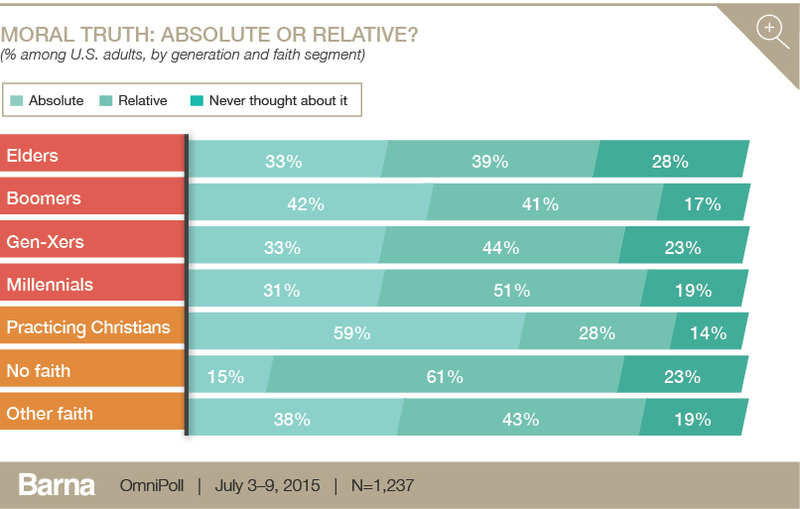
I don’t know if you saw the new research from The Barna Group revealing three-quarters of Millennials (74 percent) agree with the statement, “Whatever is right for your life or works best for you is the only truth you can know,” compared to only 38 percent of the generation of Elders (the Millennials grandparents).
How’s that for a change in morality over generations?
Truth is no longer an absolute.
Truth is no longer something found in a book.
Barna_Morality_charts_v42
Please understand. This isn’t meant as a criticism of “kids these days.” It’s actually a criticism of us—the adults who have raised them like this. One way or another we have allowed our kids to adopt a very convenient morality: Do what feels right in the moment. Go with your gut. No one can tell you what’s right for you.
How do you think young people would respond today if they had a face-to-face encounter with Jesus, and he told them:
“I am the way, the truth, and the life. No one can come to the Father except through me. If you had really known me, you would know who my Father is. From now on, you do know him and have seen him!” (John 14:6-7, NLT)
Hmmmmmm.  
This article originally appeared here.
Jonathan McKee is the president of The Source for Youth Ministry, is the author of over a dozen books including the new Get Your Teenager Talking, The Guy’s Guide to God, Girls and the Phone in Your Pocket, The Zombie Apocalypse Survival Guide for Teenager, and youth ministry books like Ministry By Teenagers, Connect: Real Relationships in a World of Isolation, and the 10-Minute Talks series. Jonathan speaks and trains at conferences, churches and events across North America, all while providing free resources for youth workers and parents on his websites, TheSource4YM.com and TheSource4Parents.com. You can follow Jonathan on his blog, getting a regular dose of youth culture and parenting help. Jonathan and his wife, Lori, and their three teenagers, Alec, Alyssa and Ashley, live in California.
Jonathan McKee

Jonathan McKee

Jonathan McKee is the author of 20 books including the brand new 52 Ways to Connect with Your Smartphone Obsessed Kid, More Than Just the Talk, Sex Matters, Connect, the 10-Minute Talks series, The Zombie Apocalypse Survival Guide for Teenagers and The Guy's Guide to God, Girls, and the Phone in Your Pocket. Jonathan speaks to parents and leaders worldwide, all while providing free resources on TheSource4YM.com and TheSource4Parents.com. Jonathan, his wife Lori and his three kids live in Northern California. JonathanMcKeeWrites.com / Twitter.com/InJonathansHead (see links at bottom of post)

Reach Out DON’T Freak Out!

Reach Out DON’T Freak Out! 7 Simple Ideas to Get Your Teens Sharing Their Faith Right Away!

Reach Out DON'T Freak Out teens share faith
“Getting teenagers to share the Gospel with their peers may seem like a daunting task.”
Getting teenagers to share the Gospel with their peers may seem like a daunting task. But when teens begin sharing their faith they begin growing in their faith. Why? Because the social risk involved forces them to trust in God, die to themselves (and how their peers perceive them) and walk in obedience to the Father.
So how can you get teenagers to share their faith? Here are seven simple ideas:

1. Teach them to share their story.

At Dare 2 Share we use a simple method called “Before-Then-After.” Have your teenagers answer the question, “What was your life like before you met Jesus?” Then have them share the “then“…”then a friend invited me to youth group“…or…”then my parents explained to me the message of Jesus“…or….”then I read the book of John in the Bible and it clicked.” Finally, have them share what their life has been like after they put their trust in Jesus.

2. Give them a faith-sharing app to use.

At Dare 2 Share we developed the Life in 6 Words app, which is an amazingly simple way for teenagers to share their faith. They simply ask a peer which six words on the app’s opening screen would best describe their life. They then ask them why they chose those words. Finally, they ask them if they could share with them how the Bible may describe life in six Words. If their friend is open they can swipe through the Gospel presentation with Bible verses on some beautifully illustrated screenshots. The app is free on iTunes or GooglePlay.

3.  Teach them to “Ask, Admire and Admit.”

When our teenagers learn how to ask good questions to get to know someone and then transition to asking spiritual questions to discover where they are at spiritually, walls begin to break down. Then they find what they can admire in their belief system. Instead of looking for areas of difference have them look for areas of commonality. This builds bridges instead of burning them. Finally, they admit the reason they are a Christian is that they are so messed up they needed Jesus to save them. After that they have opened up a door to share their story and the Gospel story. For more training on this, click here.

4. Show them how to “Salt” Gospel conversations.

Dare 2 Share has developed a series of Gospel conversation starting videos called “SALT.” They come complete with a training curriculum so that youth leaders can equip their teens to use them with their friends.
 Here’s a sample of one taken from our YouTube Channel:

Teenagers can post one of the SALT videos on their Facebook page and navigate the Gospel conversations that erupt as a result. The curriculum does a fabulous job of helping you prepare them for these important conversations.

5. Have them text a friend a question.

• “Do you believe in God?”
• “Do you have a spiritual background?”
• “Do you go to church anywhere?”
• “Have you ever wondered about the meaning of life?”
Questions like this are great opportunities for teenagers to begin Gospel conversations with their peers. You can coach them how to navigate the dialogue that are sure to ensue as a result of these kinds of questions.

6. “Gospelize” a service project.

Coordinate a local service project and make sure it has a faith sharing component to it. Too often we have an either/or mentality when it comes to outreach. It’s either service projects or evangelistic outreaches. But Jesus did both. Jesus healed both bodies and souls. He provided both bread and the Bread of Life. He gave both earthly and eternal hope.
Challenge all of your participating teenagers to engage in at least one full Gospel conversation in whatever outreach project you choose to do. After all there is no lasting justice without Jesus.
7. Take them through Shine.
Last summer I was part of a film project called “Shine.” This six-week faith sharing curriculum was filmed in the beautiful Rocky Mountains of Colorado with six Christian teenagers from across the United States. In this high energy “reality series(esque)” setting, we combined extreme activities (from rock climbing to wake boarding on a cold mountain lake to mountain biking down a huge mountain on steep dirt trails) and honest conversation to train teenagers how to naturally navigate a Gospel conversation.
Here’s a preview…

What are some other ideas/resources/tools to get believing teenagers sharing “the greatest story ever told that’s hardly ever told”?