Sebuah pelayanan yang dirintis oleh Morria Nickels di Amerika Serikat untuk melayani kaum subkultur yang tersisihkan dari masyarakat. Pada tahun 2006 telah menunjuk dan mengutus Dave Broos sebagai Regional Director di Indonesia
Justice Riders Display Large Abortion Banners on Overpasses
Columbus,
OH – June 8, 2016 – Today, teams of prolife activists will unfurl large
banners on overpasses across Columbus, OH, revealing the injustice of
abortion to hundreds of thousands of commuters. These banners will bear
graphic images of children killed by abortion, as well as text banners
to explain the photos.
Operation Overpass is one of Created Equal's efforts to create public debate about abortion this week as part of the organization's Justice Ride—a week-long training program designed to teach students how to defend preborn human rights in the public square. The Justice Rides
are inspired by the Freedom Rides of the 1960s, when activists faced
brutal treatment for their stand against the injustice of
discrimination.
Justice Ride: Operation Overpass: Who:Created Equal and student activists What: Large banners depicting abortion victims displayed above Columbus overpasses Where: Public overpass on 315 (560 Markview Rd), overpass on 71 (1059 E Lincoln Rd), overpass on 270 (6221 Bader Rd, Westerville) When: June 8, 2016 from 3:30 to 5:30 PM "This
is Created Equal's largest outreach in terms of reaching people. Since
not many Americans would willingly choose to see the faces of the
victims of the greatest atrocity in our country, we must bring the
victims before them. Non-consensual educational methods are not usually
welcome, but they have historically been essential in changing public
opinion on the hot-button issues of the day." – Mark Harrington,
National Director, Created Equal Can't join us on the road? You can still be part of the Justice Ride with your generous gifts. WILL
YOU FINANCIALLY SUPPORT THE JUSTICE RIDE? YOUR GIFT OF $10, $20, $30,
OR MORE ALLOWS US TO MENTOR FUTURE LEADERS WHO JOIN US ON THE ROAD. You can give online HERE
or send your check to: Created Equal, PO Box 360502, Columbus, OH
43236. Your gift is tax deductible to the fullest extent of the law. Ready to hit the road, Mark Harrington, National Director, Created Equal Find us on Facebook, follow us on Twitter and Instagram, listen on the radio, and subscribe on Youtube. Click here to forward this email to a friend! Click here to see a web copy of this email.
Parents face unique
challenges in raising tech-competent kids. On one hand, we want to help
them discover the beauties of the web landscapes. But we also want to
protect them from harmful content as they learn the critical skills of
digital self-control.
In our home, our kids (ages 14, 11 and 8) love the web, and can
easily find their way around computers and devices. One even attends
classes online. But as the interests and devices in our home have
multiplied, we have had to rethink how to set web restrictions.
Snakes in the Garden
To understand why restrictions are a priority in the first place, let
me rewind the story of creation all the way back to the beginning of
God’s garden, where Adam was given two purposes: “to work it and keep
it” (Genesis 2:15).
For the garden to flourish, Adam was to labor in the soil (“work it”),
and he was called to protect and guard it (or “keep it”). He would sweat
and dig, discern and defend.
This language of working and keeping, used first of Adam, is later applied in Scripture to God’s priests (see Numbers 18:5–6).
Adam functioned not only as the first husband and father, but also as a
prototype of God’s first priest in God’s first temple (Eden).
Eve didn’t yet exist when God made the prohibition forbidding the tree of the knowledge of good and evil (Genesis 2:16–18).
Although Eve took the first bite of the forbidden fruit and was guilty
in her own right, the first sin was an epic leadership failure by Adam.
He was called to celebrate God’s truth, to obey in faith and to keep the
snakes out. But he let the deceiver in, failed to protect Eve and the
garden from satanic lies, and bears the guilt for their sin.
Parenthood in the Digital Age
The implications of this illustration pertain to moms and dads of young kids, but I feel it especially as a dad.
Adam’s initial calling in Eden shapes my calling as a dad in the
digital age. Satan has been speaking lies since Eden. Even to this day,
through digital communication, the slippery snakes in the world lie to
us in the form of masters of marketing, prophets of materialism and
empires of pornography. These deceivers try to slip into our homes
invisibly through wifi signals.
Apart from the serpent crusher, Jesus Christ, there’s no way for any
father or mother to keep all corrupting influences out of the lives of
our children, and no way to eternally protect our children from the
consequences of alluring lies. The second Adam is our ultimate solution.
But in the calling of the first Adam, I sense my own calling to keep and to protect and to guard the digital space of my home.
Out of this paradigm I want to know what websites and content passes
through the router in our home. I want to address concerns—not by
setting up a “nanny state,” but by training our children to understand
limits (of content and time) as they learn to embrace the preciousness
of Jesus Christ, who is more treasurable than any of the emptiest
digital offerings they will ever see on a screen.
The Circle
So how is this done in the digital age?
For Windows 10 users, I’m told the platform was built with impressive
parental controls, based on their user-centered system. But we are a
Mac family.
For the past six months, my wife and I have been using a device
called Circle, a little white cube (yes, Circle is shaped like a cube)
and it sells in the U.S. for about $99.
It’s not a wifi router, and no wifi data passes through it, so Internet
speeds are not slowed down. The Circle is something of a wireless
sidecar, acting as a barrier to step in and block certain web content
from getting from the wifi router to a specific device in your home.
The industry calls it “ARP spoofing,” an old tool of the hacking trade, now redeemed and made commercially available.
The initial setup was easy:
1. I downloaded and installed the free Circle app onto the master device (for me, my iPhone).
2. I unboxed the Circle device and plugged it into an outlet in the same room as the pre-existing wifi router.
3. I introduced it to the home’s wifi network (wirelessly), and paired it with the iPhone app.
4. From this point, every device that connects to the home wifi was identified and listed in my app automatically.
5. Next, on my iPhone app, I created accounts for each person in the house.
6. Then I assigned each device to one person’s account (individual devices cannot be assigned to multiple accounts).
7. Then I determined settings and limits for each user, a setting
that equally regulates all the computers and devices assigned to that
person.
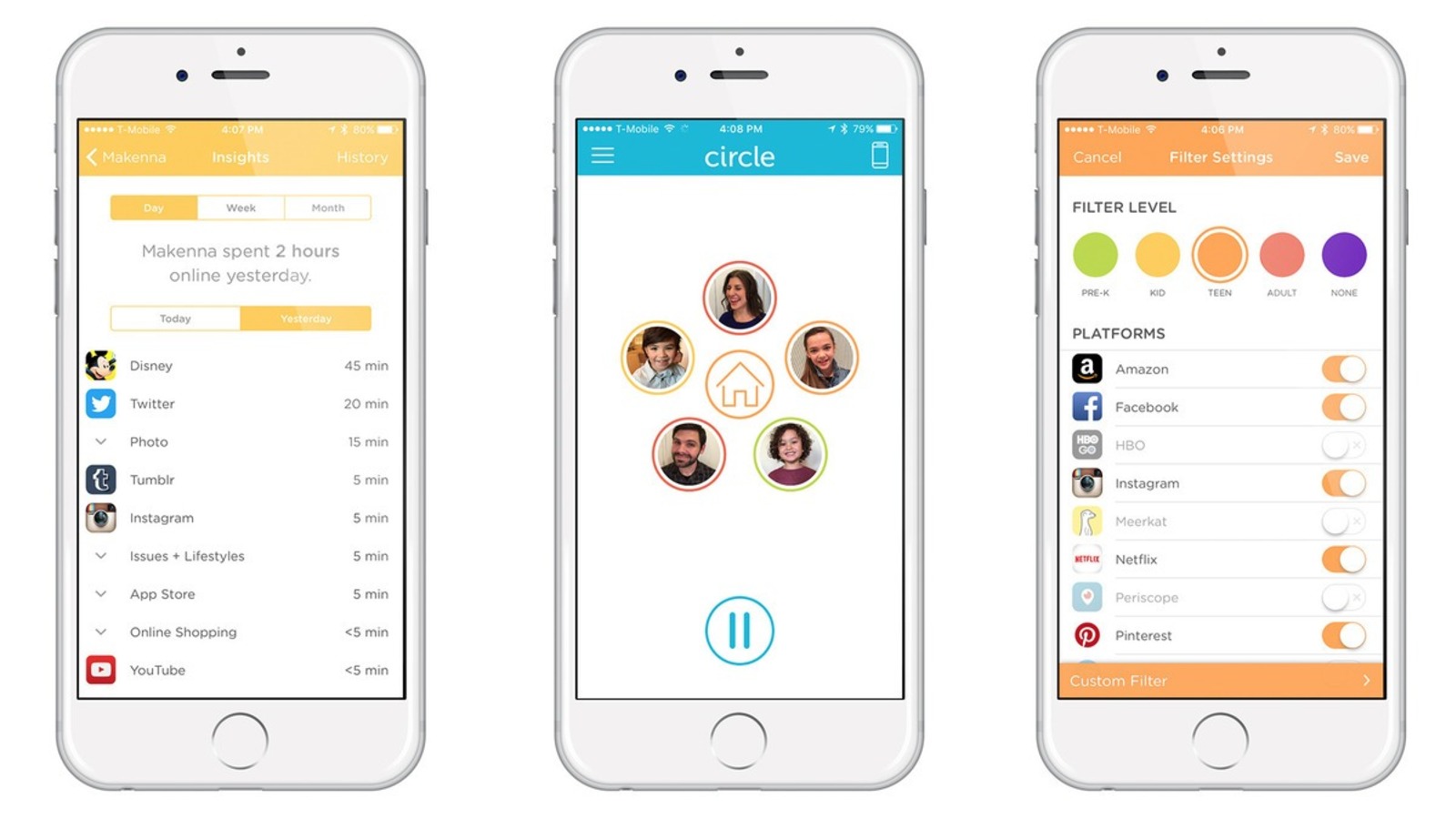
Circle Settings and Limits
All sorts of controls are possible from the master device to run the
Circle, which governs what web data is allowed in. For each user there
are default filter settings for pre-K, kid, teen, adult and none.
It is easy to manually toggle on/off access to specific platforms,
for example: Amazon, Facebook, FaceTime, HBO, Hulu, Instagram, Meerkat,
Minecraft, Netflix, Periscope, Pinterest, Reddit, Snapchat, Tumblr,
Twitter and YouTube.
And simple to manually toggle on/off access to certain categories,
such as: app store, blogs, business, chat + forum, creative arts,
education, email, family, games, government + politics, health, hobbies,
home + food, issues + lifestyles, music, news, online shopping, photo,
science + technology, search + reference, social media, sorts, travel,
video, VPNs and proxies.
Three helpful privacy toggles (on/off) include: ad blocking, Google safe search and YouTube restricted viewing.
Custom filters allow parents to program custom URLs that can be toggled on/off.
Bedtimes can be set to shut off all wifi service between a sleep time and a wake time.
Time limits can be set for specific sites and categories (for
example, 30 minutes of YouTube per day, per user, across all their
devices).
A feature called “Insights” registers a list of all the URLs browsed,
and time spent online, and a list of all sites that were blocked by the
Circle.
And on the home screen is a giant pause button. At any time, with one
push of the button, all web activity can be stopped in the home or for
one particular user.
Circle Pros/Cons
The Circle pros:
• There’s no loss in wifi signal strength or speed.
• All the features outlined above work impressively well.
• The device simplifies parental web control, eliminating the need for setting internal controls in each wifi device.
• For kids using home wifi, it renders accountability software unnecessary.
• The master app is remote, so I can modify the Circle settings on my iPhone from anywhere in the world.
• The device also works to toggle wifi service to Apple TV or other streaming television devices.
• It is versatile enough to handle a range of ages.
• The default “home” settings are immediately applied to any foreign
device that connects to the home’s wifi, but is not assigned to a
specific user.
• The Circle uses a backup battery so the device cannot simply be unplugged and circumvented by crafty kids.
The Circle cons:
• The Circle app used on the master device is only currently available for Apple products.
• By definition, the Circle blocks data from the web; it cannot regulate native apps or games on a device.
• If your child has a mobile phone, you cannot restrict access to
data from cell towers (something to be remedied in a future
subscription-based service called “Circle Go”).
• It is currently not possible to assign multiple users to one
device. The family computer, say, must be assigned to one user (or to
the “home” settings). However, you can adjust the settings on-the-fly to
accommodate different users.
• All bedtimes and time limits operate on a single setting for seven
days of the week, making changes from weekday limits to weekend limits a
manual task.
• Our first Circle crashed after four months.
Circling Back
When power is lost to the device, my iPhone is alerted with a push
notification: “Your Circle has been unplugged.” But it wasn’t unplugged.
And about three months in to our Circle experience I was alerted: “Your
Circle is offline!” Then an hour later: “Your Circle is back online!”
The next day the same thing happened and the Circle was offline (i.e.,
disabled) for about an hour. Nobody was at home at the time, it was
never unplugged, the blinking light on the back never stopped flashing.
After about three weeks of intermittent offline/back online prompts it
went offline permanently. It would not pair again with my phone. The
device died.
Circle support responded quickly to my email, asking: Did you move
your router? (No.) Is this the same iDevice that was used to manage
Circle before? (Yes.) Have there been any changes to the network set up
or Firewall? (No.)
A replacement was shipped immediately with a postage paid UPS sticker
to return the original. The new one arrived, I set it up, and it’s been
working well for two months.
One Tool to Tend the Garden
Parents who want to develop a tech-friendly, but discerning home, who
want to train their children for the unrestricted web they will someday
face alone, face a difficult task. We need God’s wisdom to use parental
technology to help establish healthy limits in our home without
exasperating our children. We want to be careful not to trample upon the
wonders of all the un-forbidden fruit of the worldwide garden, but we
need to train them to know that there are forbidden places of the web to
avoid. A simple device built on a hacker’s trick will not explain all
this to them, nor will it give them the necessary self-control they will
need later in life.
But in the work of online filtering, Circle 1.0
is a promising move in the right direction to facilitate parental
controls. And yet, for all its promise in helping parents protect the
digital space of our homes, it also reminds us of the fallenness of this
world. While keeping the snakes out may be getting a little easier, our
lines of defense (in this life) will never be automatic.
Columbus,
OH – June 7, 2016 – Dozens of college and high school students will
deliver flyers to neighbors of Karl Schaeffer, a local abortionist,
today. As Schaeffer continues to kill children, our Justice Riders are committed to making his grisly practice known.
This outreach is part of Created Equal's efforts to create public debate about abortion this week as part of the organization's Justice Ride—a week-long training program designed to teach students how to defend preborn human rights in the public square. The Justice Rides
are inspired by the Freedom Rides of the 1960s, when activists faced
brutal treatment for their stand against the injustice of
discrimination. Mark
Harrington, National Director of Created Equal, stated, "Those who kill
children attend churches in our community, shop at local grocery
stores, and get gas at the corner station. But no one knows who they are
because they don't wear badges reading, 'I Kill Children.' We will not
allow the killing to remain hidden behind closed doors." Can't join us on the road? You can still be part of the Justice Ride with your generous gifts. WILL
YOU FINANCIALLY SUPPORT THE JUSTICE RIDE? YOUR GIFT OF $10, $20, $30,
OR MORE ALLOWS US TO MENTOR FUTURE LEADERS WHO JOIN US ON THE ROAD. You can give online HERE
or send your check to: Created Equal, PO Box 360502, Columbus, OH
43236. Your gift is tax deductible to the fullest extent of the law. From the road,
Mark Harrington, National Director, Created Equal Find us on Facebook, follow us on Twitter and Instagram, listen on the radio, and subscribe on Youtube.
Right now, 45.8 million people
around the world are living in slavery. The shocking number is part of
the 2016 Global Slavery Index released by the Walk Free Foundation,
which showcases just how prevalent the problem remains around the world.
Their ability to gather new data and research deeper into the problem
has led to them finding 28% more slaves than just two years ago. Even
though holding people against their will and the selling of human beings
is illegal throughout the world, in many countries, human trafficking,
bonded labor and forced labor remain common practices.
India was far and away the worst offender in terms of sheer numbers.
There, more than 18 million people live in slavery. However, when it
comes to the most slaves per capita, North Korea—which is ruled by a
tyrannical dictator—was actually worse. Because of the country’s massive
labor camps that house hundreds of thousands of political prisoners,
more than 4 percent of the entire population lives as slaves.
However, there was some good news. The organization found that some
countries—including India—have begun to make significant steps to
increase penalties for trafficking, slavery and child labor.
Organizations like the Walk Free Foundation and International Justice Mission
provide individuals with opportunities to help in both advocacy and
legislative campaigns to one day end the practice of human slavery.
Read
more at
http://www.relevantmagazine.com/slices/new-report-finds-nearly-46-million-people-are-currently-living-slavery#CA2tzZtRosooVAL9.99
Free eBook: “9 Evangelism Insights That Will Transform Your Ministry” by Greg Stier
Gain crucial insight into a youth ministry strategy for both spiritual and numerical growth.
Free eBook
Download and share this free eBook with your leadership team.
From Dare 2 Share, “See more fruit in your ministry. We all want to
see new believers and deeper discipleship in our youth groups, and this
innovative FREE resource from Greg Stier of Dare 2 Share will help you
do just that.This free PDF download will: Offer a youth ministry strategy for both spiritual and numerical growth, give you tools to inspire your teens toward relational evangelism and spell out simple ways to make evangelism an integral part of your youth ministry.”
An image from the Bible has a lot to say about your ministry.
What’s the secret to a highly effective youth ministry? Rocks!
I love the Bible’s obsession with rocks. In Genesis 28:18
Jacob used a rock as a pillow of sorts and then anointed it with oil as
a memorial to his God-induced vision/dream the night before. Then
there’s the pile of rocks that Joshua had the Israelites stack up in Joshua 4:19-24
as a commemoration of the crossing of the Jordan river into the
Promised Land. And, of course, all of us remember that single, smooth
rock hurled from the sling of David that took out a giant in 1 Samuel 17:50.
God loves to use everyday, ordinary objects (like rocks) and everyday,
ordinary people (like David) to accomplish extraordinary missions.
But that’s not the point of this blog (although the Bible’s
consistent allusions to stones and rocks as metaphors and
illustrations are interesting to me.) No, the point of this blog is that
rocks are the secret to a highly effective youth ministry.
Allow me to explain.
The late Dr. Stephen Covey gave a powerful illustration in his wildly successful book The 7 Habits of Highly Effective People. And it had to do with, you guessed it, rocks!
Here is the illustration in his own words: One day this expert was speaking to a group of business students
and, to drive home a point, used an illustration I’m sure those students
will never forget. After I share it with you, you’ll never forget it
either. As this man stood in front of the group of high-powered
over-achievers he said, “OK, time for a quiz.” Then he pulled out a
one-gallon, wide-mouthed, mason jar and set it on a table in front of
him. Then he produced about a dozen fist-sized rocks and carefully
placed them, one at a time, into the jar. When the jar was filled to the top and no more rocks would fit
inside, he asked, “Is this jar full?” Everyone in the class said, “Yes.”
Then he said, “Really?” He reached under the table and pulled out a
bucket of gravel. Then he dumped some gravel in and shook the jar
causing pieces of gravel to work themselves down into the spaces between
the big rocks. Then he smiled and asked the group once more, “Is the jar full?”
By this time the class was onto him. “Probably not,” one of them
answered. “Good!” he replied. And he reached under the table and brought
out a bucket of sand. He started dumping the sand in and it went into
all the spaces left between the rocks and the gravel. Once more he asked
the question, “Is this jar full?” “No!” the class shouted. Once again he said, “Good!” Then he
grabbed a pitcher of water and began to pour it in until the jar was
filled to the brim. Then he looked up at the class and asked, “What is
the point of this illustration?” One eager beaver raised his hand and said, “The point is, no
matter how full your schedule is, if you try really hard, you can always
fit some more things into it!” “No,” the speaker replied, “that’s not the point. The truth this
illustration teaches us is: If you don’t put the big rocks in first,
you’ll never get them in at all.”
What’s true of rocks in a jar is true of priorities in a youth
ministry. If you want to make prayer a bigger priority in your youth
ministry you must program it in first. It must be on your calendar and
in your weekly youth ministry programming. The same is true with
relational evangelism, student discipleship and leadership development.
Too often our youth ministries are full of the sand and gravel of
goofy games, fun videos and massive pizza parties. As a result, we have
little room left for the bigger rocks that can make a deeper impact.
Don’t get me wrong—pizza is fine and games are fun but without the big
rocks programmed in first the weighty stuff of youth ministry can easily
get left out of the programming jar.
Our proclaimed values are either true youth ministry priorities or
empty platitudes depending on whether or not they get programmed. I’ve
seen this with youth ministries across the country, especially in the
area of evangelism.
While many youth leaders say that evangelism is a big priority, it’s
often not reflected in their weekly programming. Perhaps they do
a quarterly outreach meeting, but our biggest priorities get
programmed into our weekly meetings, not our quarterly ones. If I tell
my wife that she is a priority, but only talk to her once a quarter,
then she’s not a priority at all. If I say that evangelism is a
priority, but I only push it once a quarter, then it’s not a priority at
all.
If you’d like to learn how you can make evangelism (and six other
rocks) a bigger priority in your weekly youth ministry programming,
then click here to download a free e-resource that will help you do just that. Also take time to download this free PDF
filled with practical ideas from youth leaders across the country to
help you advance the Gospel and put the big rocks in first!
Let’s start programming our biggest priorities into our weekly meetings!
Rock on!
How to talk to the students who don’t seem to have any interest in listening.
Jonathan McKee is
the author of 20 books including the brand new 52 Ways to Connect with
Your Smartphone Obsessed Kid, see them all here.
A few months ago a youth worker from El Paso, Texas, called me up and
asked, “Do you want to speak at school assemblies for a week in Texas?”
If I would have answered him honestly, I would have responded, “No way!”
Why? Because who would be stupid enough to get up in front of a bunch of kids who don’t want to hear a speaker… and try to speak to them?
I guess I’m that stupid. That’s why in this post I’m going to give
you three tips I’ve learned along the way that have helped me when
speaking to kids in difficult venues like
school assemblies. (And please pray for me today—I’ve done six
assemblies so far this week, and do two more today and then a big event
tonight!) Tip #1: Realize “I Suck” I’ve been speaking to teenagers for 25 years. People actually
hire me to do it. I probably spoke to about 5,000 teenagers last year
alone (and I speak to far more parents and leaders than teens). And do
you know what keeps me going more than anything else?
I know I’m nothing without God’s help.
Please don’t take this as cliché. It’s not. The only way I have a
chance at making any kind of impact in the lives of teenagers is to
humble myself before God and admit, “I need you for this … bad!”
Beware of the speaker who says, “I got this.”
We don’t got this. He does. And He lets us be a small part
of the process. The second you realize that, you’re one step closer. So
bathe this whole process in prayer. Tip #2: Weave a Series of Stories In my early years of ministry I spoke to middle school kids
weekly on campus. In those years I quickly discovered one of the most
effective tools that could actually hold the attention of wirey,
distracted, ADHD tweens: Stories.
Stories work. In fact, when I first realized this, I couldn’t believe how powerful Bible stories were. “Jesus was walking down the road with a bunch of his followers
and he came to a city that no one liked. And in the middle of the city
no one liked was a woman no one liked sitting by herself. So Jesus
walked up to her and started a conversation…”
Try it. You’ll be shocked. “One day God spoke to a prophet named Jonah. He said, ‘Jonah, I
want you to go talk to a group of people in the city of Ninevah.’ Jonah
winced. ‘Ninevah? Are you serious? No one should ever associate with …
those people.’ God said, ‘Well, I don’t care what other people say; I
want you to go tell them the truth. Let’s see how they respond.’ Jonah
waited until he thought God wasn’t looking, and then he ran away …”
Stories captivate kids. In fact, the biggest trick is practicing the
sentences you have to say between stories so kids don’t tune out in
those few seconds.
That’s the secret of my two books with ready-made talks, 10-Minute TalksandMore 10-Minute Talks.
Those books are simply stories, with a wrap up, scripture and small
group questions. Easy peasy. (I don’t really know what that means … but
my father-in-law says it all the time.)
Guess what? This works for adults too. Some of the best speakers are master storytellers. Tip #3: Make Fun of Yourself Humor is powerful. Some of us are funnier than others, but all of us can make fun of ourselves.
Last week I listened to an Andy Stanley sermon online. If you don’t
know Andy, he’s truly one of the most amazing Christian communicators of
this century. The guy is a bright light helping people easily
understand God’s word and readily apply it to their lives. Phenomenal!
Anyway … in his sermon he began telling a story about himself going to
one of his kid’s sports games. This humorous anecdote wasn’t just funny,
it helped him connect with his audience The story painted him as normal
and imperfect … just like me. The story made me laugh at him, mankind and myself.
Don’t be afraid to give examples from you own life. Pretend you’re in
a small group studying a passage of scripture and someone asks you,
“Share a time when you learned this … the hard way.” Typically you can
think of something.
Humor breaks down walls, and vulnerable, personal stories (not
inappropriate, just transparently human) help people relate to what
you’re communicating. Jonathan McKee is the author of 20 books including the brand new 52 Ways to Connect with Your Smartphone Obsessed Kid, More Than Just the Talk, Sex Matters, Connect, the 10-Minute Talks series, The Zombie Apocalypse Survival Guide for Teenagers and The Guy’s Guide to God, Girls, and the Phone in Your Pocket. Jonathan speaks to parents and leaders worldwide, all while providing free resources on TheSource4YM.comand TheSource4Parents.com. Jonathan, his wife Lori and his three kids live in Northern California. JonathanMcKeeWrites.com / Twitter.com/InJonathansHead